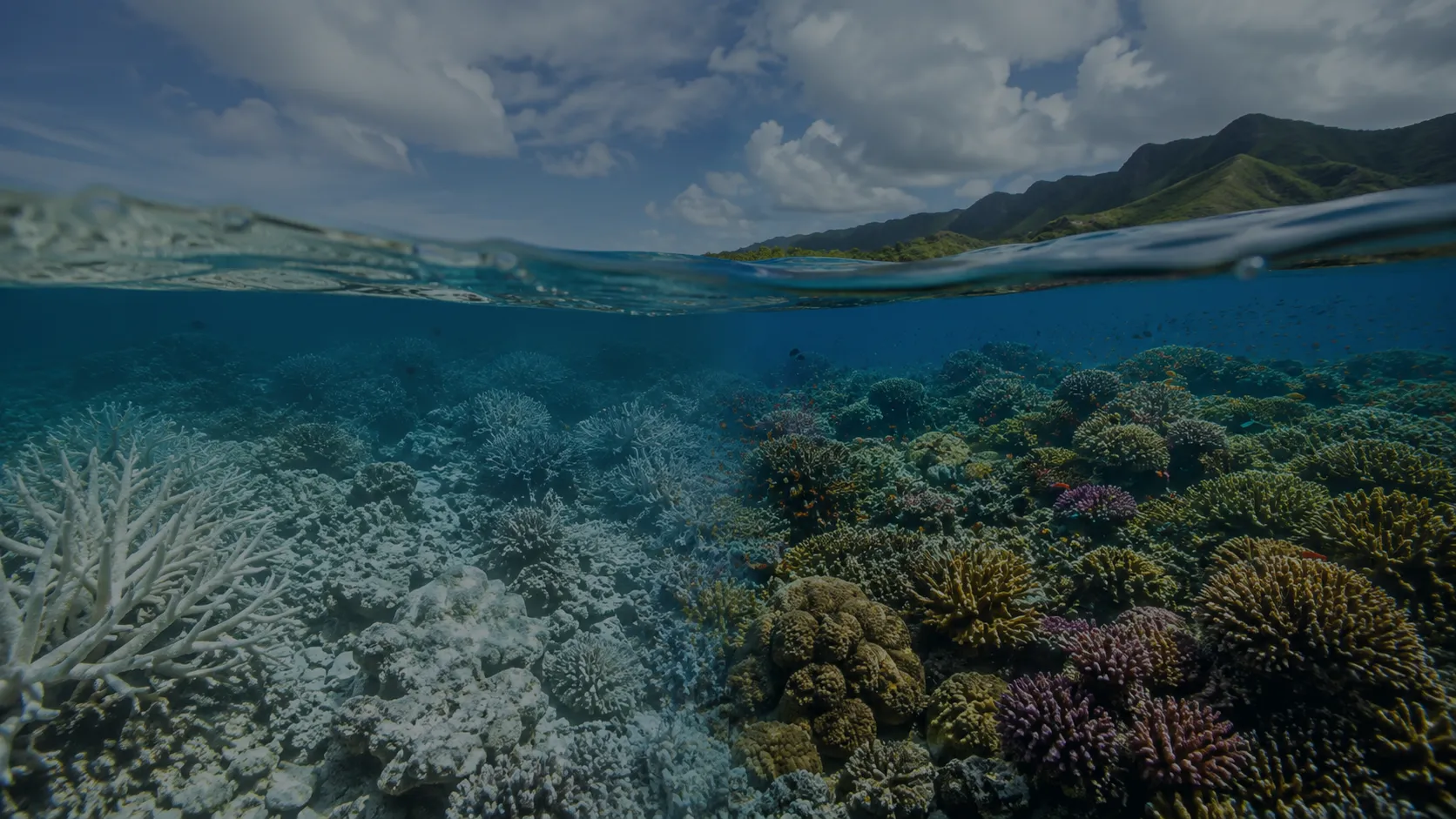
A coral reef beneath clear ocean water

WellThought

WellThought Foundation

A nonprofit applying systems thinking to education, technology, conservation, and the preservation of human knowledge.

Explore the work
Evidence before scale Knowledge for public benefit

Our throughline

Understand the whole system, then test where change can matter.

The portfolio spans children's learning, knowledge preservation, and ecological research. Each project begins with relationships: what depends on what, where knowledge is missing, and what a responsible intervention would need to prove.

Project portfolio

Three areas of work. One public mission.

Projects are grouped by what they serve: children's learning, human knowledge and history, or living ecosystems.

01

Children's learning

Free and approachable tools that help children explore language, mathematics, evolution, and connected worlds through play.

Mobile game concept Evolution and civilization

Living Worlds

An open-world ecological civilization game where evolution, genealogy, and ecology are not lesson modules. They are the systems that govern the world across human and animal generations.

Read more Hide details

What makes it different Every simulated organism can have parents, offspring, inherited traits, a life history, and descendants. The player can follow one animal across time while a human family, a settlement, and an ecosystem develop together.

  • Species arrive when the habitat can support them rather than when the player reaches an arbitrary level
  • Visible variation, inheritance, mutation, survival, and reproduction allow populations to change over generations
  • Domestication emerges from repeated interaction and selective pressure, including a possible wolf-to-dog lineage
  • The player character ages and dies, then play continues through a descendant who inherits the changed world
  • Ecology becomes part of the civilization technology tree: healthy systems create the conditions for new capabilities

Players learn through consequences. Removing wolves can change deer abundance and forest regeneration. Favoring tolerant wolves can begin domestication. The simulation creates the question “Why did that happen?” and gives the player tools to investigate it.
Published Vocabulary

Vocab Aloud

Many children's learning apps interrupt practice with long ads, subscriptions, or locked lessons. Vocab Aloud keeps read-aloud review, examples, quizzes, and spelling practice free and uninterrupted.

Read more Hide details

Children can hear words spoken aloud, review definitions and example sentences, practice spelling, and revisit words that need more attention. Profiles and progress remain on the device.

  • No account required
  • No ads or in-app purchases
  • Local profiles and progress
  • Short practice sessions designed for independent use

Published by Daeda Technologies. Any future nonprofit role will be documented separately.

Early concept Mathematics

Times Table

Basic multiplication practice should not require enduring long ads or paying to unlock the useful part. Times Table will be a free, calm practice tool built around understanding and recall.

Read more Hide details

The concept begins with quantities and patterns, then gradually introduces recall. Children should be able to see why a multiplication fact is true before being asked to answer it quickly.

  • Visual arrays before memorization
  • Practice organized by fact family and current confidence
  • Optional timed challenges rather than mandatory pressure
  • Offline progress without a child account

An early prototype will test the progression from visual reasoning to fluent recall with children, caregivers, and educators.

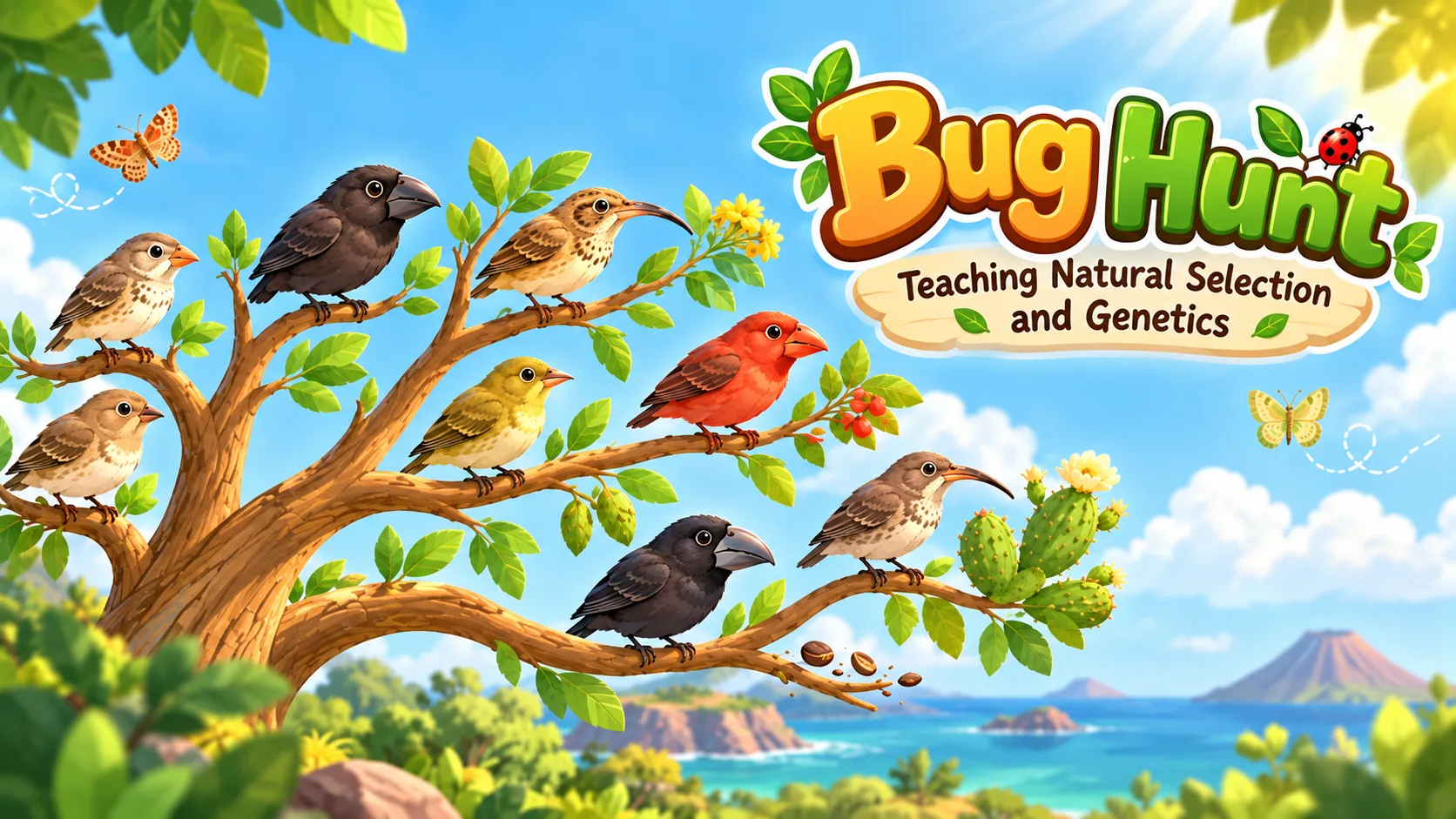
Bug Hunt illustration showing birds with varied inherited beak traits
Natural Selection Lab Bug Hunt Hawk Hunt Camouflage Hunts Beak Buffet
Read more Hide details

What makes it different The learner becomes part of the selection pressure. Captured animals leave the breeding population, survivors become parents on screen, and the next generation visibly inherits their traits.

  • Hawk Hunt shows how predator decisions and costly identification mistakes change which snakes survive
  • Camouflage Hunts let inherited color variants compete across different habitats
  • Beak Buffet connects inherited body structure with feeding efficiency and reproductive success
  • Random mutation and chance prevent the “best” trait from winning automatically

Bug Hunt is an experimental playground rather than a quiz. Learners predict, act, watch reproduction, compare generations, and test a new hypothesis while the game makes clear that populations evolve; individual animals do not change because they need to.

Launch game
02

Knowledge preservation

Preserving professional judgment, lived experience, and historical context that institutions would otherwise lose.

Living Expertise concept showing an expert interview becoming searchable, preserved knowledge
Pilot concept Knowledge and history preservation

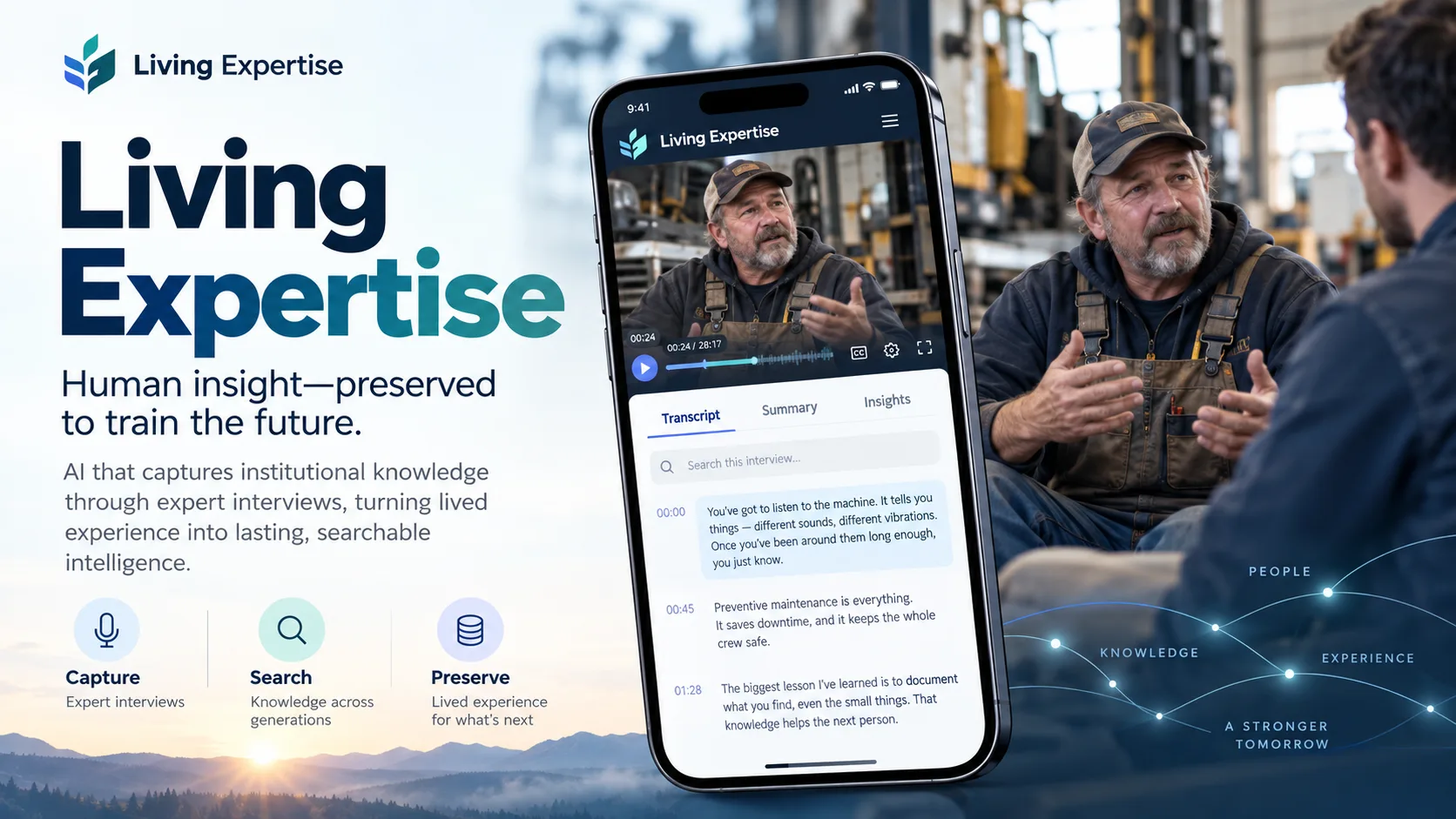
Living Expertise

An oral-history AI platform that preserves expert testimony in its original form, maps connections and disagreements, and makes approved knowledge searchable without letting generated language impersonate the expert.

Read more Hide details

What makes it different Living Expertise treats the recording, transcript, evidence, consent, and provenance as the authority. AI acts as a cited interface to the archive, not as a synthetic replacement for the person.

Problem

Traditional documentation captures procedures, but rarely preserves failed approaches, tradeoffs, tacit signals, or why a decision made sense at the time.

Approach

Record source-grounded expert interviews, connect them to transcripts and evidence, and make the resulting knowledge searchable across people and generations.

  • Knowledge Relay uses structured interviews and follow-up questions to capture judgment, failed approaches, informal dependencies, and decisions made under uncertainty.
  • EchoGraph connects experts, institutions, events, claims, corroboration, disagreement, and unresolved knowledge gaps.
  • Expert Agents cite recordings and timecoded transcripts, distinguish recollection from inference, and refuse when the archive lacks evidence.
  • Contributors choose access levels and retain correction, challenge, restriction, and prospective withdrawal workflows.

The five-expert prototype sets a high bar: at least 95% of evaluated factual agent claims must have valid supporting sources before the project advances.

Capture Verify Search Preserve
03

Living systems

Careful research into interventions that may help reefs, kelp forests, and ocean food webs recover.

Concept-stage pilot Event-triggered reef resilience

ReefGuard

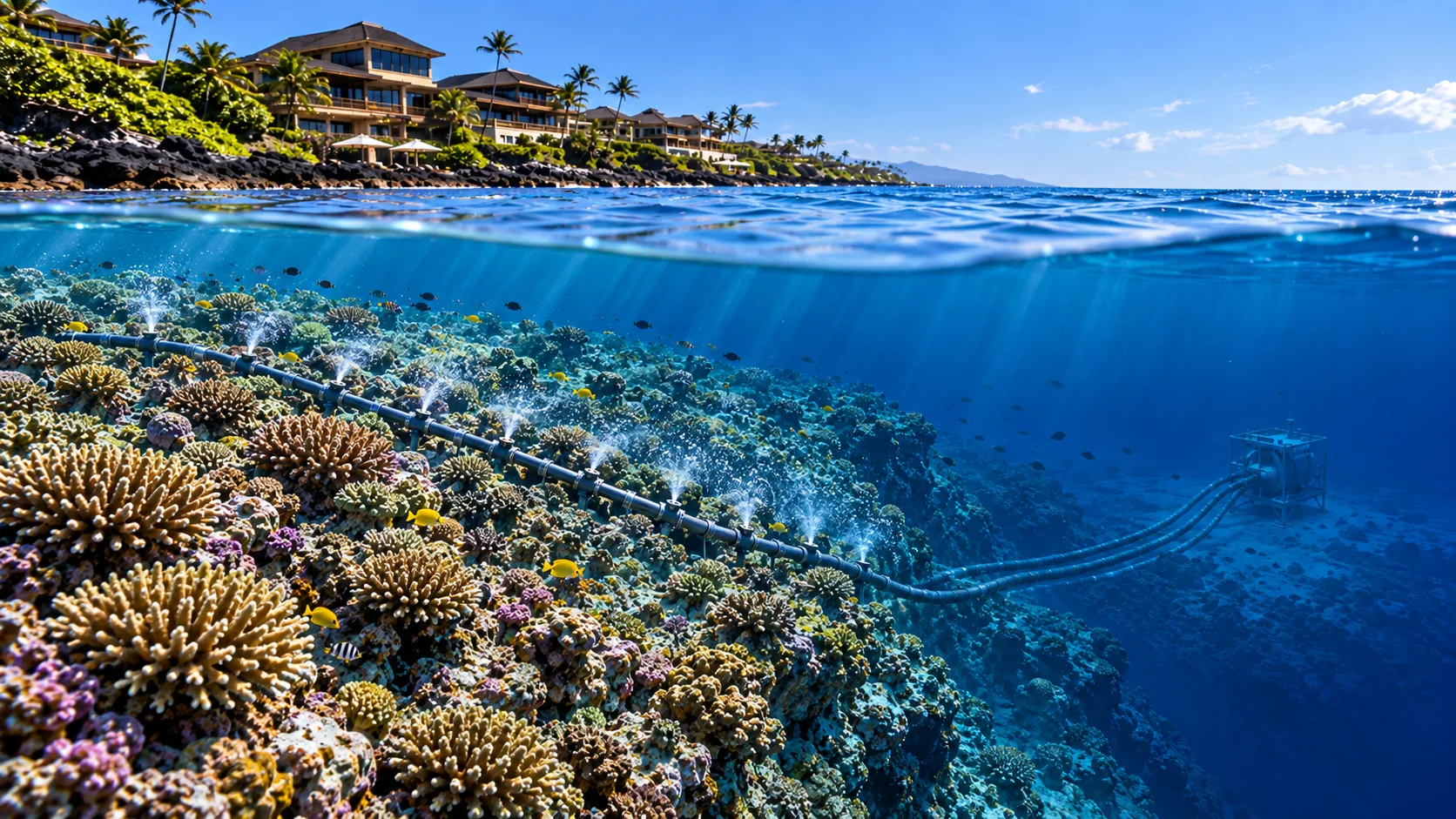
A threshold-triggered thermal-buffering system that activates during acute heat stress, moves cooler subsurface water across a bounded reef patch, and measures the response against a control zone.

Read more Hide details

What makes it different ReefGuard is event-triggered intervention rather than permanent climate control or passive monitoring. It is designed to reduce collapse-level thermal peaks while preserving normal environmental variation.

  • Local sensors detect stress above a site-specific baseline and activate the system gradually
  • A modular pump, hose, and diffuser network moves cooler water only during an acute event
  • Bathymetry, currents, source-water chemistry, intake effects, and energy demand determine whether a site can proceed
  • Independent monitoring compares the treated reef with a control zone using predefined stop thresholds
  • The equipment remains reversible and fully retrievable rather than becoming permanent ocean infrastructure

Each validated deployment would add to a repeatable operating and regulatory playbook: intervention-linked thermal data, permitting evidence, biofouling and storm experience, and ecological outcomes rather than hardware alone.

Feasibility research Conservation robotics

Kelp Recovery

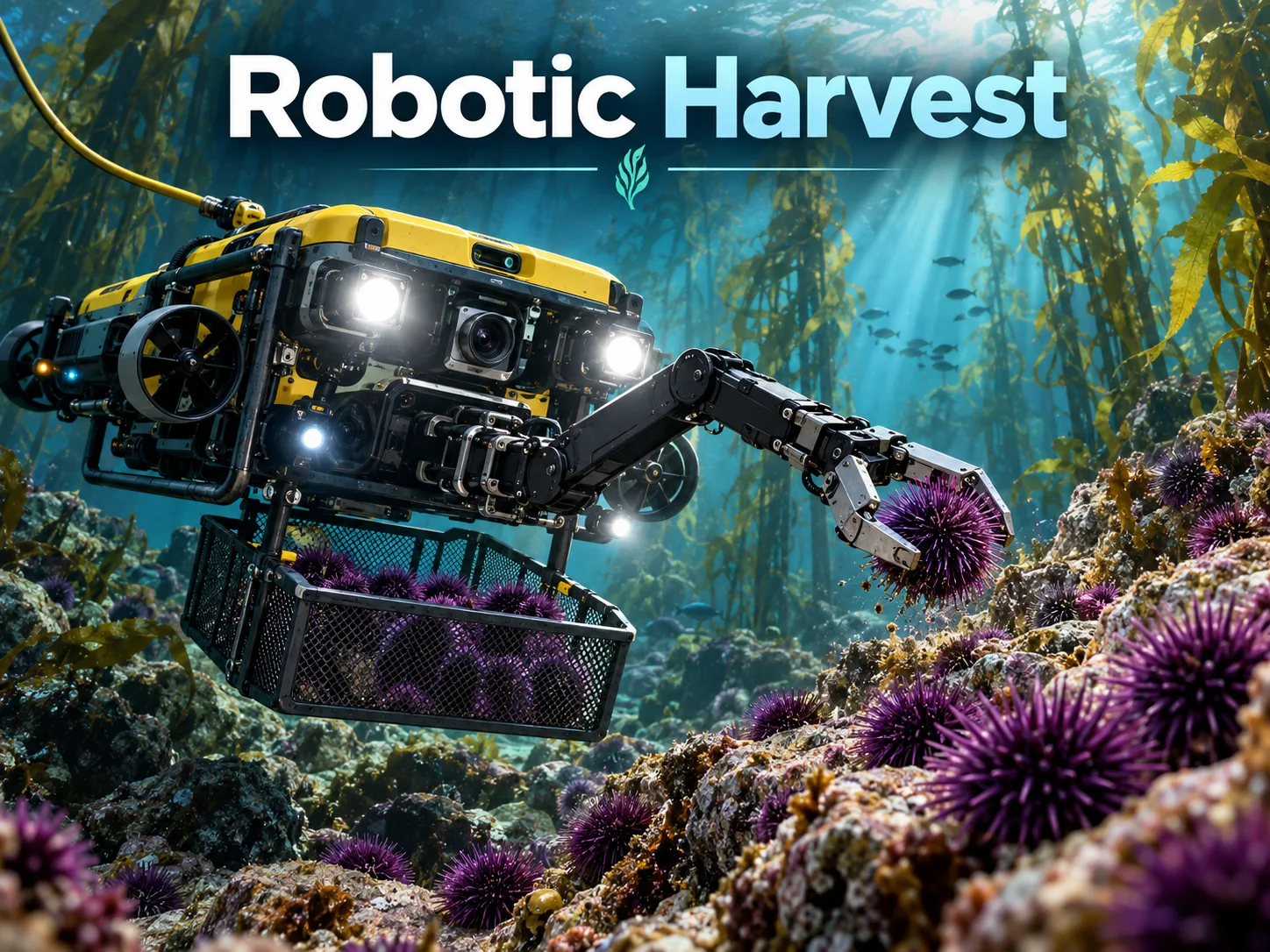
A conservation-robotics program that selectively collects excessive purple urchins from persistent barrens, measures whether a diverse kelp forest returns, and investigates whether responsible use of the biomass can help finance restoration.

Read more Hide details

What makes it different The project joins selective underwater robotics, traceable ecological intervention, long-term recovery measurement, and a restoration economy. It does not treat removal volume as success.

  • A human-supervised tethered ROV keeps an operator responsible for every early collection decision
  • Computer vision estimates species, size, density, and location while a compliant gripper and removable basket reduce bycatch and disturbance
  • Every collection event can be recorded, mapped, and linked to before-and-after habitat observations
  • Treatment and control areas track kelp recruitment, biodiversity, substrate effects, recolonization, and the need for active seeding
  • Food and non-food uses for harvested biomass may offset restoration costs and create work for coastal communities

The program advances only if it can demonstrate sustained ecosystem recovery. Evidence that removal does not work at a site is a valid and important result.

Explore the restoration plan
Research agenda Deep ocean

Marine Snow

Investigating how changes in marine life may have altered the flow of biological material into deep-ocean food webs.

Read more Hide details

What makes it different The research connects two histories that are usually studied separately: industrial changes to whales, fish, and plankton near the surface, and the amount, timing, and composition of food reaching ecosystems far below.

  • Reconstruct whale falls, fish biomass, migration, particle export, and regional productivity from historical records
  • Test competing causal structures with biogeochemical and food-web models that preserve uncertainty
  • Look for historical signals in sediment cores, stable isotopes, eDNA, cameras, and protected-versus-exploited sites
  • Define observations that could falsify the central hypotheses rather than assuming a delayed effect exists

The goal is a public evidence map, reproducible historical dataset, causal model, and a focused field-research agenda before any remediation proposal is considered.

Living systems project

Kelp Recovery

A selective restoration system that combines underwater robotics, ecological measurement, responsible biomass use, and coastal work. A persistent, diverse kelp forest is the outcome it has to prove.

Concept illustration of a supervised underwater robot collecting purple sea urchins in a kelp forest
Concept visualization of the proposed selective collection system.
Defining difference

The robot is only one part of the system. The program links each selective collection to mapped habitat data, monitored treatment and control areas, recovery outcomes, a chain of custody for harvested biomass, and stop criteria when the intervention causes harm or fails to support recovery.

01

Why intervene

Purple sea urchins are native and belong in kelp ecosystems. The problem arises when predator loss, marine heatwaves, and other pressures allow unusually dense populations to maintain an urchin barren. Repeated grazing can consume new kelp before a forest re-establishes.

02

How we plan to remove them

The first serious prototype is a human-supervised tethered ROV with computer vision, a compliant gripper, and a removable collection basket. An operator makes each collection decision while the system maps density, records location, and watches for non-target organisms.

03

What success means

A pilot would compare bounded treatment and control areas over time. We would measure urchin density, juvenile and adult kelp, biodiversity, substrate disturbance, recolonization, and whether active kelp seeding is also needed.

California evidence

California resource agencies recognize targeted urchin removal as a kelp-restoration method when grazing pressure is a primary cause and conditions can support kelp regrowth.

CDFW lists removing urchins among restoration methods practiced in California and documents monitoring of removal efforts.

Ocean Protection Council reported that a North Coast pilot removed nearly 50,000 pounds of purple urchins and observed a significant increase in bull kelp density at Noyo Bay that did not occur at the control site.

Urchin removal will not restore every kelp forest. Poor water quality, sedimentation, limited spores, disease, persistent warm water, and other conditions may prevent recovery even after grazing pressure falls. The project therefore uses staged testing, independent review, and stop criteria.

Living systems project

ReefGuard

Reversible reef-protection infrastructure designed to activate during acute thermal stress, reduce the worst temperature peaks, and verify whether the intervention produces a biological benefit.

Concept model of the ReefGuard thermal-buffering system distributing subsurface water across a coral reef near a resort
Concept visualization of a modular ReefGuard installation.
Defining difference

ReefGuard treats a marine heatwave as a threshold event. Sensors trigger a bounded response only when stress crosses a site-specific baseline. The system then ramps down, remains retrievable, and compares the treated reef with a control zone. The product is the verified operating system around the intervention: evidence, approvals, safeguards, and repeatable deployment practice.

01Sense

Local sensors identify heat stress above a site-specific baseline.

02Trigger

Control logic activates gradually only during an acute event.

03Move water

A modular pump, hose, and diffuser distribute cooler subsurface water.

04Verify

Temperature and reef response are measured against a control zone.

Initial market

Riviera Maya resort corridor

The concept-stage plan starts where reef heat risk, tourism economics, and potential shared beneficiaries overlap. One anchor resort, nearby hotels, and a government or grant layer could finance a common reef-protection asset.

Delivery sequence

  1. Feasibility, bathymetry, and regulatory pre-check
  2. Customer letters of intent and technical white paper
  3. Environmental review, engineering, and vendor scope
  4. Controlled deployment through a heat-stress season

Concept-stage economics

Feasibility
$50K-$150K
Pilot setup
$500K-$1.5M
Annual service
$200K-$600K

Related literature

Books that extend the ideas.

Founder-authored stories exploring motivated reasoning, internal validation, and epistemic humility.

Outreach and support

Start a conversation.

Reach out about a project, research collaboration, institutional partnership, volunteering, or supporting the foundation's work.

Research partnerships Project support Donor conversations

Opens your email app with this message prepared. Nothing is sent until you send it.

Founder

Van T. Truong

An enterprise DevOps architect and technical product leader building across education, research, environmental technology, and knowledge systems.

View founder profile